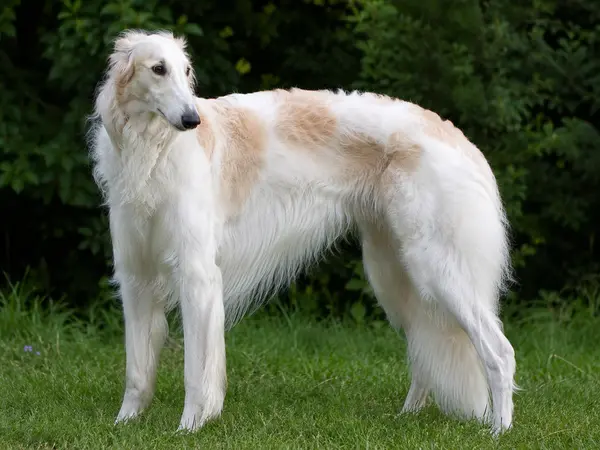
A Sighthound Born of Russian Aristocracy
The Borzoi carries itself with the quiet self-possession of a breed shaped by centuries of privilege. Developed by Russian nobility to course wolves across open steppe, these dogs were never common working animals. They were the exclusive pursuit of princes and landowners, bred for speed, courage, and an independent mind capable of making life-or-death decisions in the field. Understanding this history is not optional for anyone considering a Borzoi. It explains almost everything about how they behave in a modern home, why they ignore commands they consider irrelevant, and why they will never be a casual walking companion on a busy sidewalk.
The breed's original name translates simply as "fast," a word borrowed from an old Russian root that has persisted across centuries. For much of the twentieth century, English-speaking countries knew them as the Russian Wolfhound, a name that lingered until breed organisations reverted to the original terminology. Either name refers to the same animal: a tall, narrow sighthound built for explosive acceleration and sustained pursuit over open ground.
Hunting with the Russian Aristocracy
Coursing with Borzois was a formalised spectacle. Before a hunt, horses would drive wolves into an open area where hounds waited in pairs, held by handlers on foot. Once a wolf broke free, a Borzoi pair would be released. Their job was to pursue, overtake, and pin the wolf by the ears and neck until the hunters arrived on horseback. This required not only speed but considerable nerve. Wolves are dangerous quarry, and a hound that hesitated or lost heart was of no use in the field.
The breed's role in aristocratic hunting shaped its temperament in ways that persist today. Borzois were bred to work at a distance from their handlers, making independent assessments of terrain and quarry. They were expected to make decisions without human guidance. This selective pressure produced a dog that still struggles with the concept of obeying commands it finds unnecessary or confusing. A Borzoi's refusal to recall is not defiance. It is the distillation of generations of breeding that valued autonomous judgement over blind compliance.
Russian hunting culture also demanded dogs that could transition between intense bursts of fieldwork and complete stillness in the home. Borzois were housed in kennels and brought out for hunts, but they were also welcomed into drawing rooms and treated with a reverence typically reserved for livestock. This dual role created a breed with two distinct modes: focused and explosive outdoors, remarkably placid indoors.
Physique: Tall, Narrow, and Built for Speed
Borzois stand between 26 and 30 inches at the shoulder, with females at the lower end and males reaching the upper limit. Weight ranges from 60 to 105 pounds, though the numbers are misleading without visual context. A Borzoi's body is extraordinarily narrow for its height. The chest is deep but compressed laterally, the abdomen tucked sharply upward, and the overall impression is one of elegant verticality rather than bulk. They look like a creature designed to slip through gaps.
This narrow build has practical consequences. Borzois can compress their bodies to fit through spaces that would seem impossible for a dog of their height. Standard crate sizes that accommodate other breeds of similar weight may be too narrow. Doorways, garden gates, and even gaps in fencing present less of a barrier than they appear. Their physical design, optimised for aerodynamic efficiency, makes containment a serious consideration rather than an afterthought.
The long, silky coat, which ranges from flat to wavy with generous feathering on the legs, chest, and tail, adds to their visual elegance but also demands regular attention. The head, long and narrow with a refined Roman nose, carries a gentle expression that belies the dog's actual temperament. Borzois do not look intimidating, which can lead owners to underestimate the consequences of their independence.
A Quiet and Reserved Disposition
Borzois are not anxious dogs, nor are they shy in any conventional sense. They are, however, reserved with strangers and cautious in unfamiliar environments. This is not a breed that greets visitors with exuberant enthusiasm. A Borzoi may observe newcomers from a distance, approach on its own terms, and then retreat to a preferred resting spot. Forcing interaction or encouraging a Borzoi to be more sociable than it wishes to be produces nothing except a dog that avoids the people trying too hard.
In the home, Borzois are quiet to an almost uncanny degree. They do not bark without reason, and their reasons are few. They may vocalise when a doorbell rings or when something genuinely unusual occurs, but the daily sounds of household life rarely provoke a response. This quietness extends to physical movement. Borzois move through a house with minimal disturbance, gliding rather than padding, and their ability to lie completely still for hours gives them an almost ghostly presence.
Children can live happily with Borzois, but the relationship requires supervision and realistic expectations. Borzois are tolerant but not playful in the way retrievers or herding dogs are. A Borzoi will accept a child's presence without complaint, but it will not chase a ball in the garden or engage in wrestling. Older children who understand the dog's need for space typically fare better than toddlers who cannot read the subtle signals of disinterest.
Independence Over Obedience
Prospective owners who imagine a Borzoi performing reliably off-lead in public spaces or responding to commands with the immediacy of a Border Collie are in for a significant adjustment. Borzois are intelligent, but their intelligence runs along a different axis than what most people expect. They learn quickly what benefits them and ignore what does not. Training a Borzoi requires patience, consistency, and an acceptance that the dog's cooperation is a negotiation rather than a command performance.
Recall training is the most common flashpoint. A Borzoi that spots a squirrel, cat, or deer at distance will almost certainly pursue it regardless of any previous training. The visual pursuit instinct is deeply embedded and overrides learned behaviour in a way that is not a training failure but a breed characteristic. Borzois were bred to chase and catch prey at speed, and that programming runs far deeper than any recall cue. Owners who trust off-lead Borzois in unfenced areas are taking a risk that no amount of training can fully mitigate.
Positive reinforcement works best, but even consistent reward-based training produces a dog that obeys selectively. Borzois are not defiant in the way some breeds are. They simply weigh each command against the current situation and make their own assessment. This is exhausting for owners who want a predictable, compliant dog. It is, however, deeply satisfying for those who appreciate a dog that thinks independently and rewards patience with occasional, genuinely voluntary cooperation.
The Visual Pursuit Instinct
Sighthounds are defined by their reliance on vision over scent, and Borzois are among the most visually driven of all sighthound breeds. Their eyes are positioned to provide a wide field of view, and their brains are wired to detect movement at extreme distances. A Borzoi in a field may lock onto a rabbit at 300 metres and begin pursuit before the owner has even registered the rabbit's presence.
This instinct creates specific management challenges. In an urban or suburban environment, moving objects trigger chase responses. Joggers, cyclists, skateboarding children, and other dogs running in parks can all activate the pursuit sequence. A Borzoi that has committed to a chase will not respond to verbal cues. It is not ignoring the owner. The dog's neurological state has shifted to a predatory focus that excludes irrelevant stimuli, including the sound of its name.
Secure, enclosed areas provide the only reliable environment for off-lead exercise. The enclosure must be genuinely secure, because Borzois are tall enough to clear many fences and narrow enough to exploit gaps that other breeds cannot fit through. Double-gated systems, solid fencing at least six feet high, and regular checks for damage or weak points are practical necessities, not precautions for nervous owners.
Interactions with Small Animals
The same visual pursuit instinct that makes Borzois poor candidates for off-lead exercise in open areas also governs their behaviour around small animals. Cats, rabbits, guinea pigs, and small dogs can coexist with Borzois under managed conditions, but the risk is real and permanent. A Borzoi that has been raised with a cat from puppyhood may tolerate it inside the home, but this tolerance does not extend to cats that enter the garden or appear at distance.
Small animals that move unpredictably trigger the chase response. This is not aggression. A Borzoi chasing a cat is not angry at the cat. It is executing a predatory sequence that has been refined over centuries. The outcome of a chase is rarely favourable for the smaller animal, and owners who believe their Borzoi's household tolerance of a resident cat extends to all cats and small animals are making a dangerous assumption.
Supervision around visiting pets should be constant and unrelenting. Even a Borzoi that has never shown interest in the household hamster may react differently to the same animal when it is running across the floor. Predatory drift, the shift from tolerance to pursuit triggered by movement, is unpredictable and can occur without warning.
Sensitivity to Harsh Handling
Borzois respond poorly to corrections, raised voices, and physical discipline. This is not a breed that will absorb harsh treatment and emerge with improved behaviour. Instead, a Borzoi that is subjected to aversive methods will withdraw, become increasingly uncooperative, and may develop avoidance behaviours that resemble fearfulness. The dog is not afraid of the owner. It has simply learned that cooperation leads to unpleasant consequences and has decided to reduce its exposure.
Training should be built on reward and patience. Borzois respond well to food rewards, though even here their cooperation has limits. A Borzoi that is not hungry will not perform. A Borzoi that finds the training environment stressful will not learn. The training relationship must be built slowly, with the dog's voluntary participation as the foundation.
This sensitivity extends to handling. Borzois do not enjoy being restrained, grabbed, or manipulated. Veterinary examinations, grooming sessions, and nail trims require a calm approach and, in many cases, pre-conditioning to reduce stress. The dog that stands still for a stranger in a clinic is usually the product of careful preparation rather than natural compliance.
Life in the House: Calmness as Default
Inside the home, Borzois are among the most placid dogs imaginable. They require a soft surface, proximity to their people, and very little else. They do not pace, chew furniture, or demand attention. They sleep, they rest, they observe, and they occasionally move to a different resting spot when the sun shifts. This indoor calmness is genuine, not a temporary state that precedes destruction.
The trade-off is that Borzois can become lethargic and unresponsive if their exercise needs are not met. A Borzoi that has not had adequate opportunity to run will be restless indoors, pacing or showing signs of frustration. The indoor calmness depends on the outdoor activity. These are not dogs that can be skipped on a walk and expected to lie quietly on the sofa.
Borzois also appreciate comfort. They gravitate toward soft surfaces and warm spots. Many owners report that their Borzois have claimed the best furniture in the house and will rearrange cushions to suit their preferences. This is not destructive behaviour. It is a breed characteristic shaped by centuries of aristocratic living, where comfort was assumed rather than earned.
Exercise: Safe Opportunities to Run
Borzois need space to stretch out and run at full speed. A garden is essential, not a luxury, and it must be secure enough to contain a dog that can cover ground faster than most people can run. A daily sprint in an enclosed area is the minimum requirement. Longer outings on long leads in open fields provide additional stimulation without the risks associated with off-lead exercise in unfenced spaces.
Exercise should be based on safe opportunities rather than rigid schedules. A Borzoi that has had a good run in the morning may be content for the rest of the day. A Borzoi that has been confined indoors will need more the following day. The dog's behaviour provides the clearest guide: pacing, restlessness, and attempts to escape are signals that the current exercise level is insufficient.
Heat tolerance is limited. Borzois have low body fat and thin skin, making them vulnerable to both heat and cold. Exercise in extreme temperatures should be reduced, and access to shade and water is essential in warm weather. Winter is generally more comfortable for the breed, though deep snow can slow them down and ice poses a slipping risk on their long, narrow legs.
Coat Maintenance
The Borzoi's long, silky coat requires regular brushing to prevent matting and maintain its natural lustre. A thorough session two to three times per week is sufficient for most dogs, with additional attention during the twice-yearly shedding seasons when the undercoat releases in large quantities. Matting tends to develop behind the ears, on the feathered legs, and around the neck ruff where friction from collar wear can compact the hair.
Bathing is infrequent, as the coat does not develop the odour common to shorter-haired breeds. When baths are necessary, thorough drying is essential. A wet Borzoi's coat takes considerable time to dry completely, and trapped moisture against the skin can cause irritation. Professional grooming is not typically required, though owners who are uncomfortable with the coat's volume may prefer periodic professional assistance.
The coat's condition reflects overall health. A dull, brittle coat often signals nutritional deficiencies or underlying health concerns. Regular brushing provides an opportunity to check for skin issues, parasites, or unusual lumps that might otherwise go unnoticed beneath the dense fur.
Living with a Borzoi
A Borzoi is not a dog for every household. They require owners who understand the difference between independence and disobedience, who respect the breed's historical purpose, and who can provide the secure environment their chasing instinct demands. They are not suitable for owners who want a dog that performs on command, walks politely on a lead past every distraction, or thrives in chaotic households with constant foot traffic.
The rewards of living with a Borzoi are quiet ones. There is a particular satisfaction in sharing a home with a dog that chooses to be near you rather than one that demands your constant attention. Their grace in motion, their stillness at rest, and their ability to fill a room with presence without making a sound create a companionship that operates on different terms than more conventional breeds.
For those who value calm over chaos, independence over obedience, and elegance over exuberance, the Borzoi offers something genuinely distinct. But the fit must be honest. Owners who romanticise the breed without understanding its practical demands often find themselves struggling with a dog that was never designed for the life they have in mind. The Borzoi does not adapt to its owner's expectations. The owner adapts to the Borzoi.